Sheep grazing vs row-crop agrivoltaics: how site requirements differ
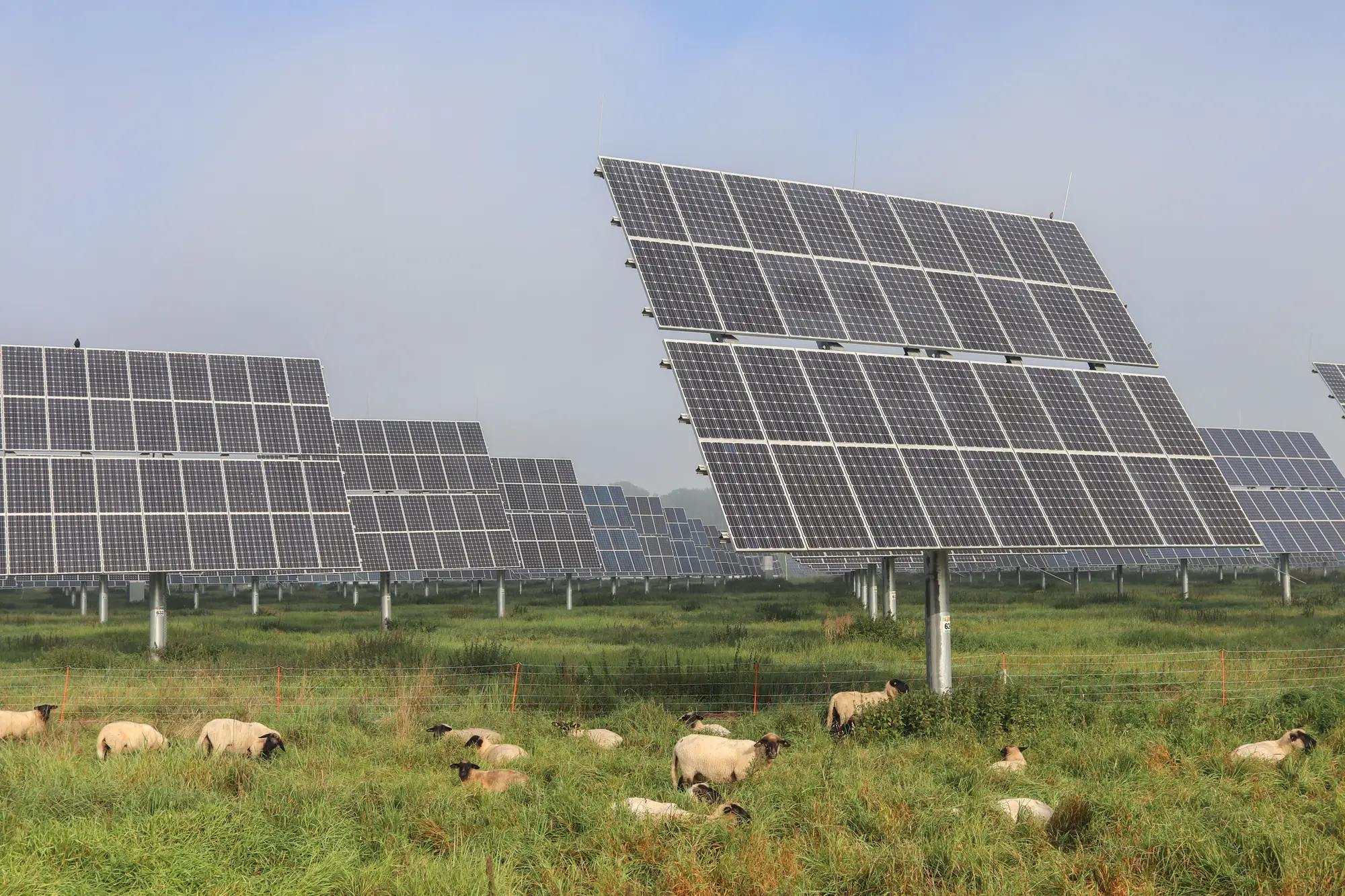
A BD lead scoping a dual-use array and a co-op partnerships officer looking at the same forty acres can land on opposite conclusions, and both can be right. It depends on what's supposed to grow under the panels. Sheep and row crops don't ask the same thing of a site, and treating "agrivoltaics" as one category instead of two is how a project ends up with panels too low for a combine or a fence line that cuts a grazing rotation in half.
Clearance and row spacing split first
Sheep need very little vertical clearance. A standard fixed-tilt or single-axis array at two to three feet off the ground works fine for grazing, which is why sheep-under-solar has become the default co-location model for utility-scale sites that never intended to farm the ground at all. Row-crop agrivoltaics is a different build. Equipment access drives everything: a tractor, sprayer, or harvester needs enough clearance and row width to turn without clipping a torque tube, which usually means raising the array to seven feet or more and widening the row spacing well past what a grazing-only design would use. That's a different racking spec, a different interconnection cost, and often a different developer conversation before the parcel is even picked.
Row spacing also changes what light actually reaches the crop. Forage grass tolerates a fair amount of shading and recovers fine under a tight row pattern. Row crops like soybeans or specialty vegetables are more particular about how much direct light they lose across a growing season, so the array layout has to leave wider gaps between rows than a grazing design would ever need.
Soil, slope, and parcel shape don't carry the same weight
A grazing parcel can tolerate rougher ground. Slope, scattered rock, and uneven drainage that would complicate row-crop equipment access are manageable for sheep, since they go where the forage is and don't need straight, level rows to work efficiently. That opens up marginal or irregular parcels to a grazing-based array where a row-crop design would get ruled out at the first site walk.
Row-crop agrivoltaics is pickier about the underlying ground. Soil type and yield history matter because the whole pitch to a co-op or a landowner is that the crop stays productive, not just present. A parcel with a documented strong yield history on that soil type and crop makes a much easier case for retrofitting it to dual use than a parcel where the crop record is thin or inconsistent. Grazing parcels don't carry that same burden of proof. Forage is forage, and a co-op usually isn't defending a specific yield number to a landowner or a lender.
Fencing and water access flip the checklist too. A grazing site needs perimeter and interior fencing plus a water source for the flock, additions that don't show up on a row-crop parcel's requirement list at all. A row-crop site needs field access wide enough for existing equipment, which is a non-issue on a sheep parcel where nothing bigger than a four-wheeler needs to get through.
Why this matters before the site visit, not during it
The expensive version of this problem is a developer and a co-op showing up with two different maps: one assuming grazing clearance and shading tolerance, one assuming row-crop equipment access and yield continuity, both pointing at the same parcel. Sorting that out on paper, from crop type, parcel geometry, and yield history, before anyone drives out is a lot cheaper than finding out in the field that the racking spec was wrong for the use case everyone agreed on.
That's the sorting problem Agrisolar Siting was built around: a seasonal candidate parcel map that separates ground likely to work for grazing from ground with the crop record to support a row-crop design, so the first site conversation starts from one map instead of two. If you're trying to tell those parcels apart before the next round of site visits, that's worth a look.